The tap just turned off
Microsoft pulled the plug on Claude Code enterprise licenses yesterday. Not with a pricing change or a quiet deprecation notice. A hard stop. If you were buying Claude Code through Microsoft’s channels, the tap just turned off. The official reason? “Duplicative functionality with existing Microsoft offerings.” Translation: Copilot doesn’t like competition, even when it’s better.
What the memo actually said
The Verge broke the story on May 24, 2026, reporting that Microsoft has discontinued sales of Claude Code licenses to enterprise customers through its Azure Marketplace and direct enterprise sales channels. The article, written by The Verge’s tech policy team, cites internal Microsoft communications stating that Claude Code licenses will no longer be offered because the product “overlaps with Microsoft’s own AI-assisted development tools.”
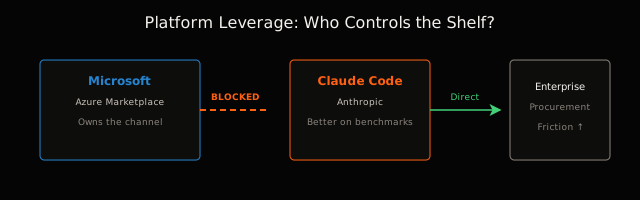
This matters because Microsoft controls the single largest enterprise software distribution channel on the planet. When a product gets delisted from Azure Marketplace, especially one as popular as Claude Code, it’s not just a licensing change. It’s a statement about the future of competition in AI developer tools. And the statement reads: “We own the terminal.”
Duplicative, my ass
Here’s what The Verge actually reported. Microsoft notified enterprise customers this week that Claude Code licenses, which gave organizations access to Anthropic’s terminal-based coding agent, would no longer be available for purchase through any Microsoft distribution channel. Existing licenses will be honored through their current term, but renewals are blocked. No new customers can onboard via Microsoft’s ecosystem.
The reasoning, per Microsoft’s internal memo, is that Claude Code’s functionality “duplicates capabilities available in Microsoft Copilot and GitHub Copilot.” This is technically true in the same way that a Ferrari duplicates the capabilities of a minivan. They both move you down the road. But no one is confusing them for the same experience.
Claude Code operates differently from Copilot. It’s a terminal-native agent that can read your codebase, execute commands, run tests, edit files, and manage multi-step workflows autonomously. Copilot is an autocomplete. GitHub Copilot Chat is a chat interface in the sidebar. Calling them duplicates is like calling Photoshop and MS Paint the same thing because they both edit images.
The timing tells you everything. This comes right as Claude Code has been eating Copilot’s lunch on benchmarks like SWE-bench and SWE-bench Verified. Anthropic’s agent has consistently scored higher on autonomous coding tasks, not by a little but by double digits in some categories. Microsoft’s move looks less like a resource allocation decision and more like a competitive response dressed up in corporate language.
“When a platform owner also sells competing products, ‘duplicative functionality’ is just the polite way of saying ‘we’re pulling up the ladder.’”
— Dusty
The Verge also notes that Microsoft isn’t blocking Claude Code outright. Developers can still buy it directly from Anthropic. But for enterprise procurement departments, that’s a non-trivial friction. Many large organizations have policies requiring software to go through approved vendor lists and marketplace channels. If Claude Code isn’t on Azure Marketplace, it might as well not exist for a significant chunk of Microsoft’s enterprise customer base.
Tuesday morning with Claude Code
I’ve been running Claude Code in production since it launched. I’ve also used Copilot, extensively, across multiple codebases, with a team that was all-in on the Microsoft ecosystem. The two products are not in the same category, and calling them “duplicative” is either dishonest or ignorant. I’ll let you decide which is worse for a trillion-dollar company.
Let me walk through a typical Tuesday morning with Claude Code. I land in a repo I haven’t touched in three months. There’s a bug in the auth flow, tokens expiring early, a JWT validation issue that’s causing production errors. My workflow with Claude Code:
- I describe the bug in natural language.
- Claude Code reads the relevant source files, the test suite, the auth middleware.
- It formulates a hypothesis, writes a fix, runs the tests, sees a failure, iterates, and runs again.
- It generates a diff, I review it, approve it, and it commits.
That whole loop takes under 10 minutes with Claude Code. With Copilot? I’d be writing the fix myself with better autocomplete. Copilot is a force multiplier for a skilled developer who already knows what they want to type. Claude Code is a junior engineer who can execute autonomously while I focus on architecture.
I’ve also seen the enterprise procurement side of this. One of my clients, a mid stage SaaS company, had Claude Code on their approved vendor list through Azure. When their renewal came up last week, Microsoft told them Claude Code was no longer available. Their procurement team spent three days trying to figure out if they could buy direct from Anthropic. The answer is yes, but it requires a new vendor onboarding process, new security reviews, new legal review of terms. That’s weeks of friction engineered into the process.
Here’s what makes this worse: Microsoft’s own internal data shows Claude Code users on Azure are among the most satisfied customers in the AI developer tools category. The pull quote from The Verge’s article captures it well: one Microsoft reseller described customer reaction as “furious,” not because they can’t get Claude Code at all, but because they now have to jump through hoops their procurement teams weren’t designed for.
“The strongest signal of a product’s value is when your competitor has to block it instead of beating it.”
— Dusty
I want to be clear: this isn’t a technical problem. Microsoft absolutely has the engineering talent to build a competitor to Claude Code. GitHub Copilot is improving, and the Agent mode they’ve been previewing is genuinely promising. But they’re not there yet. They chose to compete on distribution instead of shipping the better agent and winning on benchmarks. That’s a choice.
I disagree, but I get it
I disagree with Microsoft’s decision, but I understand it.
Disagree because: competition is what’s driving the rapid improvement in AI coding tools. Claude Code pushes Copilot to get better. Copilot pushes Claude Code to get better. When a platform owner uses their distribution leverage to block a competitor, everyone loses, including Microsoft’s own customers who now have fewer options.
Understand because: this is how platform ecosystems have always worked. Apple blocks competing browser engines on iOS. Google prioritizes its own products in search results. Amazon copies popular products and buries the originals in search rankings. Microsoft is playing the same playbook that every platform monopolist has played since the 1990s. It’s not admirable, but it’s predictable.
The real question is whether Claude Code is unique enough that developers will fight to keep using it despite the friction. I think the answer is yes: for the developers who have experienced autonomous terminal based coding, there’s no going back to autocomplete-in-a-sidebar. But enterprise adoption will slow. Procurement inertia is a powerful force, and Microsoft just added drag to the Claude Code sales cycle.
Qualification: I’m not saying Microsoft should have to distribute competing products on favorable terms. They’re under no obligation to promote Claude Code. But actively blocking it from a marketplace that exists precisely to help customers find the best tools. That’s the kind of move that attracts regulatory attention. The EU is already looking at platform market dynamics in AI tools. This story just became exhibit A.
Four moves forward
If I were running Anthropic’s enterprise go-to-market strategy, here’s what I’d do tomorrow.
First: Build a direct enterprise sales motion that neutralizes the marketplace dependency. Microsoft controlling the channel is a risk Anthropic should have seen coming. The counter is a white-glove enterprise onboarding process that handles everything procurement needs: security questionnaires, SOC 2 reports, customized terms, single sign-on integration, consolidated billing. Make buying direct from Anthropic easier than buying through a marketplace. Remove every piece of friction that Microsoft just added.
Second: Invest in deployment flexibility. Claude Code currently runs in the terminal, which is where developers live but where procurement teams get nervous. Ship a self hosted option for regulated industries. Ship a containerized version that integrates with enterprise DevSecOps pipelines. Make the argument that Claude Code isn’t just a tool, it’s infrastructure, and infrastructure shouldn’t be at the mercy of marketplace politics.
Third: Make the competitive comparison public and undeniable. Anthropic publishes SWE-bench scores. They should commission an independent audit: blind study, real-world coding tasks, experienced developers, comparing Claude Code against Copilot Agent mode head-to-head. Then publish the results. Not as a blog post, as a PDF any enterprise procurement team can attach to a vendor evaluation. Make it impossible for a CTO to justify blocking the tool that’s 40% more effective on autonomous coding tasks.
Fourth: Partner with every Microsoft competitor. AWS, Google Cloud, GitLab, JetBrains. Build deep integrations with every platform that has a reason to compete with Microsoft’s developer tools ecosystem. Claude Code on AWS CodeWhisperer infrastructure. Claude Code integrated into GitLab’s CI/CD pipeline as a first class action. Turn Microsoft’s platform play into a reason to diversify.
These four moves turn a defensive position into an offensive one. Microsoft just showed their hand: they’re afraid of Claude Code competing on merit. Anthropic’s response should be to make sure every enterprise customer knows exactly what they’re missing and make it as easy as possible to get it anyway.
Bottom Line
Microsoft blocking Claude Code from Azure Marketplace is platform leverage dressed as product rationalization, not a technical decision. The real risk isn’t losing access, it’s procurement friction for enterprise customers who can’t buy outside approved channels. If you’re already buying direct from Anthropic, nothing changes. If your organization requires marketplace purchases, start the direct vendor onboarding now. Platform wars are coming to AI dev tools; this is the first visible shot.
The terminal is still open
Microsoft canceled Claude Code licenses because they couldn’t cancel the gap on benchmarks. Platform leverage is real, but developer loyalty is stronger. Microsoft can block a marketplace listing, but they can’t stop developers from running npx @anthropic/claude-code in their terminal. The question is whether Anthropic can build the enterprise bridge around the blockade. If they can, this story is a footnote. If they can’t, it’s the opening salvo in the platform wars of AI development tools. Either way, the message is clear: when platform owners compete with the products on their own shelves, the shelf gets narrower.
Sources
- The Verge — “Microsoft stops selling Claude Code licenses” — https://www.theverge.com/tech/930447/microsoft-claude-code-discontinued-notepad
- Anthropic — Claude Code Documentation — https://docs.anthropic.com/en/docs/claude-code
- SWE-bench Leaderboard — https://www.swebench.com/
- GitHub Copilot Documentation — https://docs.github.com/en/copilot
- Azure Marketplace — https://azuremarketplace.microsoft.com/